Major 1.2 GWh Hybrid Energy Storage Project Launches in Xi’an Featuring Vanadium Flow Battery Technology

Date: 14 May 2026 |
Source: www.cpem.org.cn, 13 May 2026
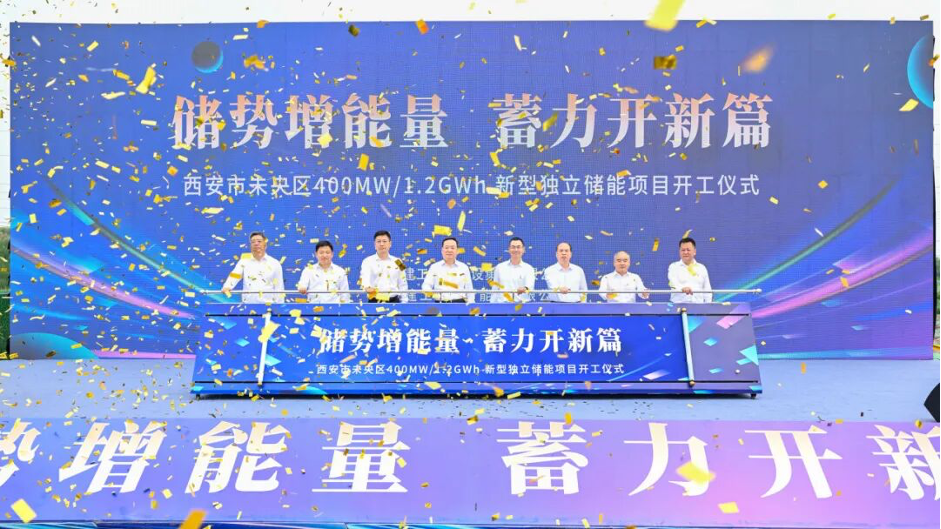
Construction has officially commenced on a major new hybrid energy storage project in Xi’an, China, combining lithium-ion and vanadium flow battery (VFB) technologies in one of the region’s largest urban energy storage developments to date.
The 400 MW / 1.2 GWh independent energy storage facility, located along Xi’an’s North Third Ring Road in Weiyang District, represents a total investment of approximately RMB 2.2 billion (USD 300 million). The project forms part of China’s continued acceleration toward large-scale grid modernization and long-duration energy storage deployment under the country’s dual-carbon (“30·60”) strategy.
The installation will utilize a hybrid configuration integrating lithium iron phosphate (LFP) batteries with all-vanadium redox flow battery technology. The combination is designed to deliver both rapid-response capability and long-duration storage performance, supporting improved grid flexibility and renewable energy integration.
According to project information released during the groundbreaking ceremony, the facility will provide:
- 400 MW power output capacity
- 1.2 GWh total storage capacity
- Up to 1.2 million kWh per charge-discharge cycle
- Electricity supply equivalent to approximately 60,000 households per day
- Annual discharge capability of approximately 610 million kWh
Once operational, the project will connect to the northern Xi’an power grid, where it will provide millisecond-level response services for peak shaving, load balancing, renewable integration, and grid stabilization.
Hybrid Storage Highlights Growing Role for Vanadium Flow Batteries
The inclusion of vanadium flow battery technology reflects the growing recognition of VFBs as a critical solution for long-duration stationary energy storage applications.
Vanadium flow batteries offer several advantages particularly suited to large-scale grid infrastructure projects, including:
- Non-flammable aqueous electrolyte systems
- Long operational lifetimes exceeding 20 years
- Minimal capacity degradation over extensive cycling
- Independent scaling of power and energy capacity
- Enhanced suitability for frequent deep cycling applications
- Improved operational safety for urban and utility-scale installations
In hybrid systems, lithium-ion batteries can provide fast-response, short-duration services, while vanadium flow batteries contribute long-duration discharge capability and enhanced system durability. This complementary approach is increasingly being adopted in China’s rapidly expanding energy storage sector.
Strategic Infrastructure and Industrial Development
The Xi’an project is also being positioned as a model for integrated clean energy infrastructure and regional industrial development. In addition to strengthening local grid reliability, the project is expected to support broader deployment of renewable energy resources and reduce electricity supply fluctuations affecting industrial and residential consumers.
Project developers stated that the facility will incorporate comprehensive environmental protection and safety monitoring systems, with no waste gas, solid waste, or significant noise emissions during operation.
The project additionally marks a strategic transition by Shaanxi Construction No. 7 Group into the renewable energy infrastructure sector, expanding beyond traditional construction activities toward integrated investment, development, operation, and maintenance services within China’s growing energy storage industry.
China continues to lead global deployment of vanadium flow battery systems, with hybrid and long-duration storage projects increasingly becoming a central component of national grid modernization efforts and renewable energy expansion.