Jiangsu’s First User-Side Vanadium Flow Battery Energy Storage Power Station Officially Connected to the Grid

Date: 28 Jul 2024 |
Source: ASIACHEM, 26 July 2024
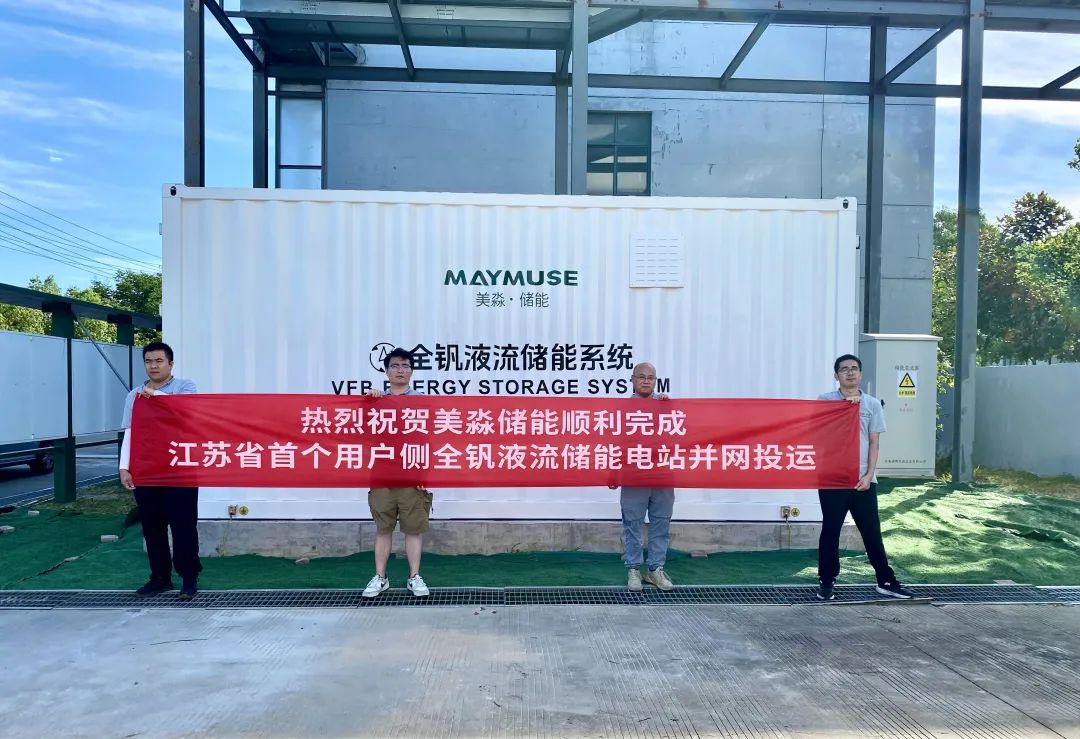
On 25 July, Jiangsu's first user-side vanadium flow battery energy storage power station project was officially connected to the grid and put into operation in Liyang, Changzhou. Designed, developed, produced, and delivered by Jiangsu Meimiao Energy Storage Technology Co., Ltd. (hereinafter referred to as "MAYMUSE"), this energy storage power station combines the development of new energy and energy storage industries. It adopts safer and longer-duration vanadium flow battery energy storage technology, addressing the "pain points" of photovoltaic power storage, smoothing power output fluctuations, and achieving a significant leap from technical achievements to large-scale industrialization.
Energy storage plays a vital role in the energy revolution. "With the rapid development of the new energy industry, converting unstable energy into stable energy through storage technology has become a crucial issue for the power system," said Ma Xin, Executive Vice President of Jiangsu Zhongke Institute of Applied Research on Intelligent Science and Technology. Currently, there are many types of energy storage technologies. Among them, electrochemical batteries, which are not constrained by geographical or spatial conditions and can be deployed modularly, are the primary choice. Electrochemical batteries are mainly divided into two types: lithium batteries and flow batteries. Lithium battery technology is mature and requires a lower initial investment, but the storage duration is generally around 2 hours and they carry risks of overheating and fire. Vanadium flow batteries are the most technologically advanced flow battery technology at present, offering intrinsic safety, high-value retention, unlimited capacity expansion at zero cost, and no secondary pollution.
At the end of 2022, MAYMUSE, in collaboration with several institutes including Zhongke Carbon Neutrality Research Institute, independently developed a user-side vanadium flow energy storage system. This system, as an innovative electrochemical energy storage technology, features a unique design where both the positive and negative active materials are vanadium ion acidic solutions stored in separate tanks. The vanadium electrolyte flows into the cell stack through external pipelines, showcasing powerful energy storage potential.
"This energy storage system can operate at room temperature and atmospheric pressure, making it particularly suitable for high-safety, large-scale, and long-duration energy storage needs. The longer the storage time, the lower the cost per kilowatt-hour," said Dr. Zhang Fengbo, Marketing Director of MAYMUSE. The vanadium flow battery technology consists mainly of core components such as the cell stack, vanadium electrolyte, and battery management system. It is intrinsically safe, with no risk of fire or explosion, a single discharge duration of 4 to 12 hours, and an overall lifespan of 20 to 25 years.
The delivered user-side vanadium flow energy storage project in Jiangsu has a storage duration of 4 hours, a design lifespan of 25 years, an annual energy storage capacity of 180,000 kWh, and can reduce carbon emissions by nearly 450,000 tons annually. This project, in collaboration with solar energy, can store excess photovoltaic power generation and achieve surplus power on the grid. Simultaneously, the factory can obtain corresponding economic subsidies through off-peak charging and peak discharging, effectively reducing corporate energy costs, improving power stability, and reducing overall capacity demand.
In November last year, MAYMUSE's gigawatt-level vanadium flow battery factory began production in Changzhou. Currently, MAYMUSE has received over 2 billion yuan in orders for user-side vanadium flow energy storage power station projects and will establish new industrial bases in many parts of the country, including Panzhihua and Shijiazhuang. This innovative energy storage system will serve independent shared energy storage power stations, chemical parks, data centers, high-rise buildings, and more, promoting the energy revolution across the industry.
Under the dual-carbon strategic goal, the proportion of renewable energy has significantly increased, focusing on building a new type of power system with new energy as the mainstay. New energy storage technology is key to promoting high-quality development of new energy. In January 2024, the National Development and Reform Commission and the National Energy Administration announced plans to promote diversified and coordinated development of new energy storage technology, focusing on high safety, large capacity, low cost, and long life, to address the system regulation needs brought about by large-scale new energy grid integration.
Flow battery energy storage is one of the most suitable long-term energy storage technologies, helping to balance power supply and demand and long-term grid regulation. Compared to pumped storage and compressed air energy storage, it offers flexible configuration, shorter construction cycles, and higher system efficiency. Compared to currently mainly used lithium batteries, it features large capacity, higher safety, and long-term energy storage.