Professor Zhang Huamin Highlights Lifecycle Cost Advantages of Vanadium Flow Batteries for Long-Duration Energy Storage

Date: 11 Jun 2026 |
11 June 2026 – As the world accelerates the deployment of renewable energy and seeks cost-effective long-duration energy storage solutions, Professor Zhang Huamin, one of the foremost pioneers of vanadium flow battery technology and a distinguished researcher at the Dalian Institute of Chemical Physics, Chinese Academy of Sciences, highlighted the growing economic advantages of vanadium flow batteries (VFBs) at the Comelan 12th International Vanadium and Titanium Industry Summit Forum in Jinzhou, Liaoning Province, China. In his presentation, Professor Zhang demonstrated that, from a lifecycle cost perspective, vanadium flow batteries are emerging as one of the most economical, sustainable, and strategically important energy storage technologies for supporting a low-carbon energy future.
In his presentation, Development Status and Prospects of Vanadium Flow Battery Technology, Professor Zhang emphasized that the rapid expansion of renewable energy generation is creating an urgent need for reliable, safe, and cost-effective long-duration energy storage solutions. As China pursues its carbon neutrality goals and continues to expand wind and solar power generation, energy storage will become an increasingly critical component of the future power system.
A central theme of the presentation was the importance of evaluating energy storage technologies based on lifecycle cost rather than initial capital cost alone. Professor Zhang explained that although vanadium flow batteries require a higher upfront investment than some alternative technologies, their long service life, low operating costs, and high residual value result in significantly lower overall costs over the lifetime of a project.
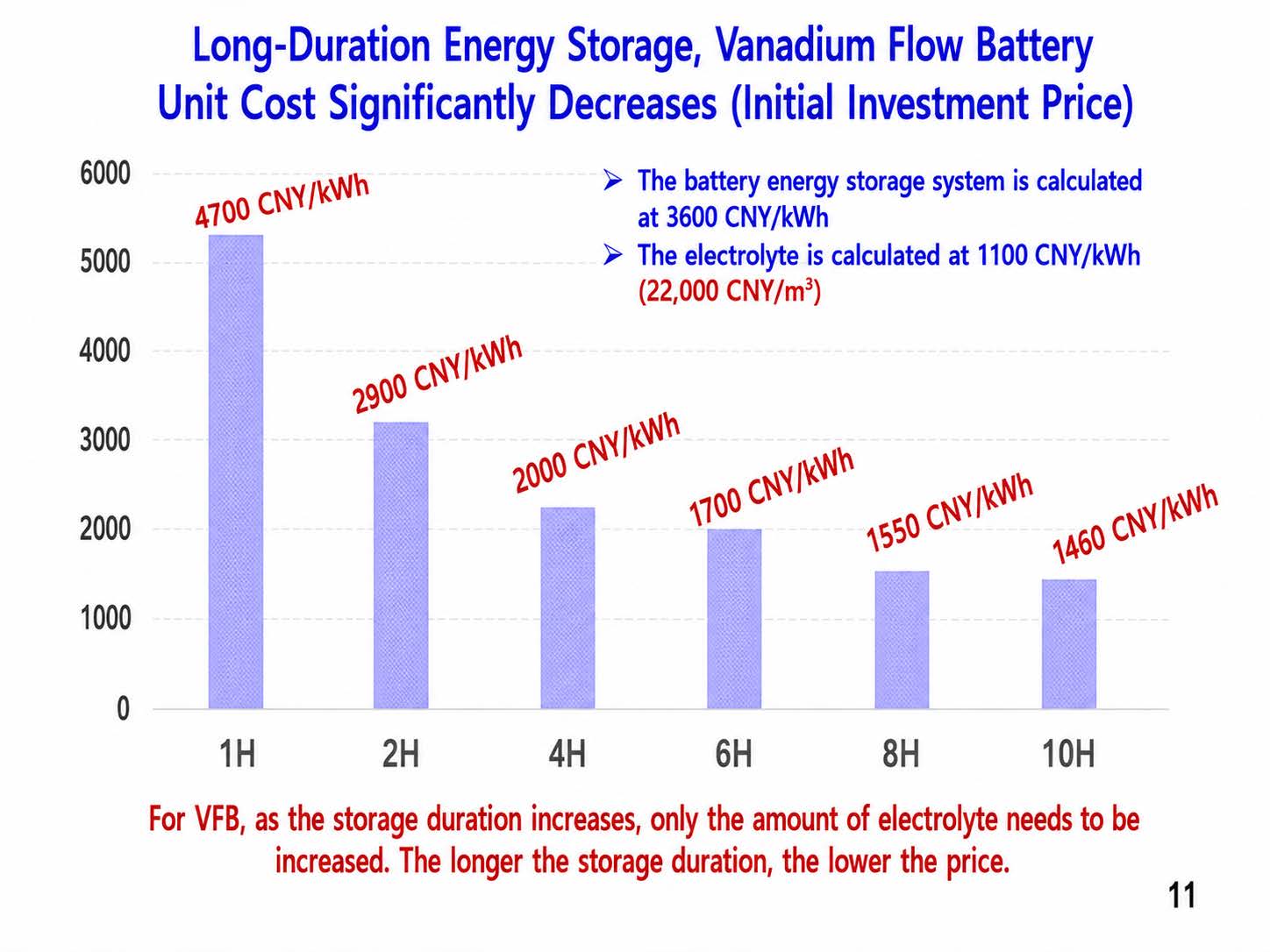
Unlike conventional batteries, vanadium flow batteries store energy in liquid electrolytes and separate power from energy capacity. This unique design allows storage duration to be increased simply by adding electrolyte, leading to substantial reductions in unit energy storage costs as storage duration increases. The analysis presented showed that the initial investment cost declines from approximately 4,700 CNY/kWh for a one-hour system to 1,460 CNY/kWh for a ten-hour system, making vanadium flow batteries particularly attractive for long-duration applications.
Professor Zhang highlighted that vanadium electrolyte represents a valuable asset rather than a consumable material. While the electrolyte accounts for a significant proportion of the initial investment, it does not degrade during normal operation and can be recovered, reused, or resold at the end of the project's life. This residual value substantially reduces the net cost of ownership and differentiates vanadium flow batteries from many competing technologies.
For a typical 1 MW/4 MWh vanadium flow battery energy storage system, the presentation estimated an initial investment cost of approximately 2,000 CNY/kWh. After accounting for electrolyte recovery and residual equipment value following more than 20 years of operation, the effective lifecycle cost falls to approximately 1,150 CNY/kWh.
The economic advantage becomes even more pronounced for longer-duration systems. For a 1 MW/10 MWh vanadium flow battery installation, the initial cost was estimated at approximately 1,460 CNY/kWh, while the effective lifecycle cost decreases to approximately 660 CNY/kWh when electrolyte recycling and residual value are included. Looking ahead, Professor Zhang indicated that ongoing technological improvements could reduce lifecycle costs further to approximately 570 CNY/kWh, reinforcing the competitiveness of the technology.
The presentation also compared the cumulative lifecycle expenditures of vanadium flow batteries and lithium-ion batteries for long-duration storage applications. Professor Zhang noted that while lithium-ion batteries may offer lower upfront costs in some cases, they typically require battery replacement during the project lifetime and incur higher operation and maintenance costs. In contrast, vanadium flow batteries offer a service life exceeding 20 years, minimal capacity degradation, excellent safety characteristics, and the ability to recover the value of the electrolyte at the end of the project. These factors contribute to a substantially lower total lifecycle cost.
To further improve economics, Professor Zhang outlined several pathways for cost reduction, including advances in electrolyte technology, membrane materials, electrodes, and stack design. Increasing operating current density and improving electrolyte utilization rates are expected to significantly reduce material requirements and system costs. Innovative business models, such as electrolyte leasing, could also help lower upfront investment barriers and accelerate market adoption.
As governments worldwide seek reliable solutions for integrating increasing amounts of renewable energy into power grids, Professor Zhang believes vanadium flow batteries are well positioned to play a central role in the global energy transition.
“From a lifecycle perspective, vanadium flow batteries are currently the most economical electrochemical long-duration energy storage technology,” Professor Zhang concluded. Their unique combination of long service life, safety, recyclability, and low lifecycle cost makes them an increasingly attractive solution for utility-scale energy storage and the development of low-carbon energy systems worldwide.