Standard Energy to Launch First Commercial Shipments of Vanadium-Ion Batteries in July

Date: 25 Jun 2026 |
Source: www.thelec.net, 24 June 2026
The first commercial shipments of vanadium-ion batteries (VIBs) from South Korean battery innovator Standard Energy are set to begin in July 2026, marking a major milestone in the commercialisation of next-generation energy storage technology.
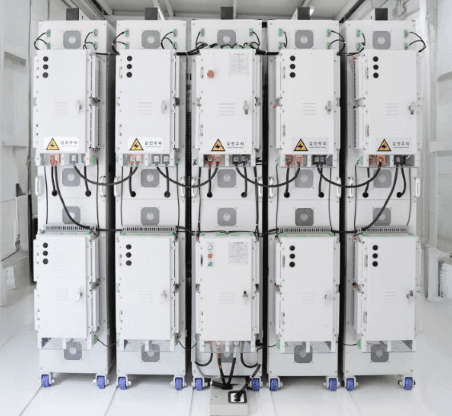
The company has completed its first automated production line at its headquarters in Daejeon, South Korea, with an annual manufacturing capacity of 50 MWh. Standard Energy expects each production line to generate more than KRW 40 billion (approximately US$29 million) in annual revenue when operating at full capacity.
Founded in 2013, Standard Energy has spent more than a decade validating its vanadium-ion battery technology through a series of commercial demonstration projects. The company has successfully deployed VIB systems across a wide range of applications, including ultra-fast electric vehicle charging stations, grid-support systems, public transport infrastructure, office buildings, university campuses and, most recently, AI data centres.
One of the earliest commercial applications was installed at an ultra-fast EV charging station in Seoul, where the VIB system helps manage the significant power surges associated with rapid charging. According to the company, the inherent safety of vanadium-ion batteries makes them particularly well suited for deployment in densely populated urban environments, where lithium-ion battery installations can present additional fire safety challenges.
Standard Energy has also demonstrated the fast-response capabilities of its technology through grid-forming projects connected directly to the Korean national power grid. In another recent application, the company installed an energy storage system at Guam Station on Daejeon Metro Line 1, enabling electricity to be stored during off-peak periods and discharged during peak demand to reduce operating costs.
The company's technology is also attracting attention from the rapidly expanding artificial intelligence sector. Working alongside AI semiconductor company Rebellions, Standard Energy developed an AI power infrastructure solution known as Dopamine, capable of responding to sudden power demand within just three milliseconds while reducing peak power consumption of AI processors by 50%. The solution received an Innovation Award at CES 2026, highlighting its potential for next-generation data centre infrastructure.
Demand for the company's batteries has already exceeded current manufacturing capacity. Standard Energy reports that the entire output of its first production line has been contracted before commercial shipments begin.
"Demand from customers is far greater than what we can currently supply," said Kim Boo-gi, Chief Executive Officer of Standard Energy.
Looking ahead, the company plans to expand production by replicating its automated manufacturing lines. A future network of 20 production lines would increase annual manufacturing capacity to 1 GWh, with projected revenues exceeding KRW 800 billion. Unlike conventional lithium-ion battery manufacturing, the vanadium-ion battery production process does not require expensive dry-room facilities, significantly reducing capital investment requirements for expansion.
Standard Energy is also strengthening its strategic partnerships across the energy sector. Earlier this year, SK On and SK Innovation signed a memorandum of understanding with the company to collaborate on advanced energy storage technologies. In addition, petrochemical companies that produce vanadium as a refining by-product have expressed interest in supplying raw materials or partnering with the company. Standard Energy has raised approximately KRW 130 billion in funding to date and is targeting an initial public offering within the next two years. The company was also recognised as the only Korean business included in TIME magazine's "World's Top GreenTech Companies 2025" list.
The commencement of commercial shipments represents an important milestone not only for Standard Energy but also for the broader energy storage industry, demonstrating growing confidence in vanadium-based battery technologies as safe, scalable solutions for renewable energy integration, grid resilience, electric mobility and AI infrastructure.