Vanadium Strengthens Resistance to Hydrogen-Induced Cracking in High-Strength Steels, Vanitec Expert Highlights at Beijing Conference

Date: 03 Nov 2026 |
Dr David Crowther highlights scientific evidence showing how vanadium improves hydrogen trapping, reduces cracking risks and supports safer, stronger steel applications
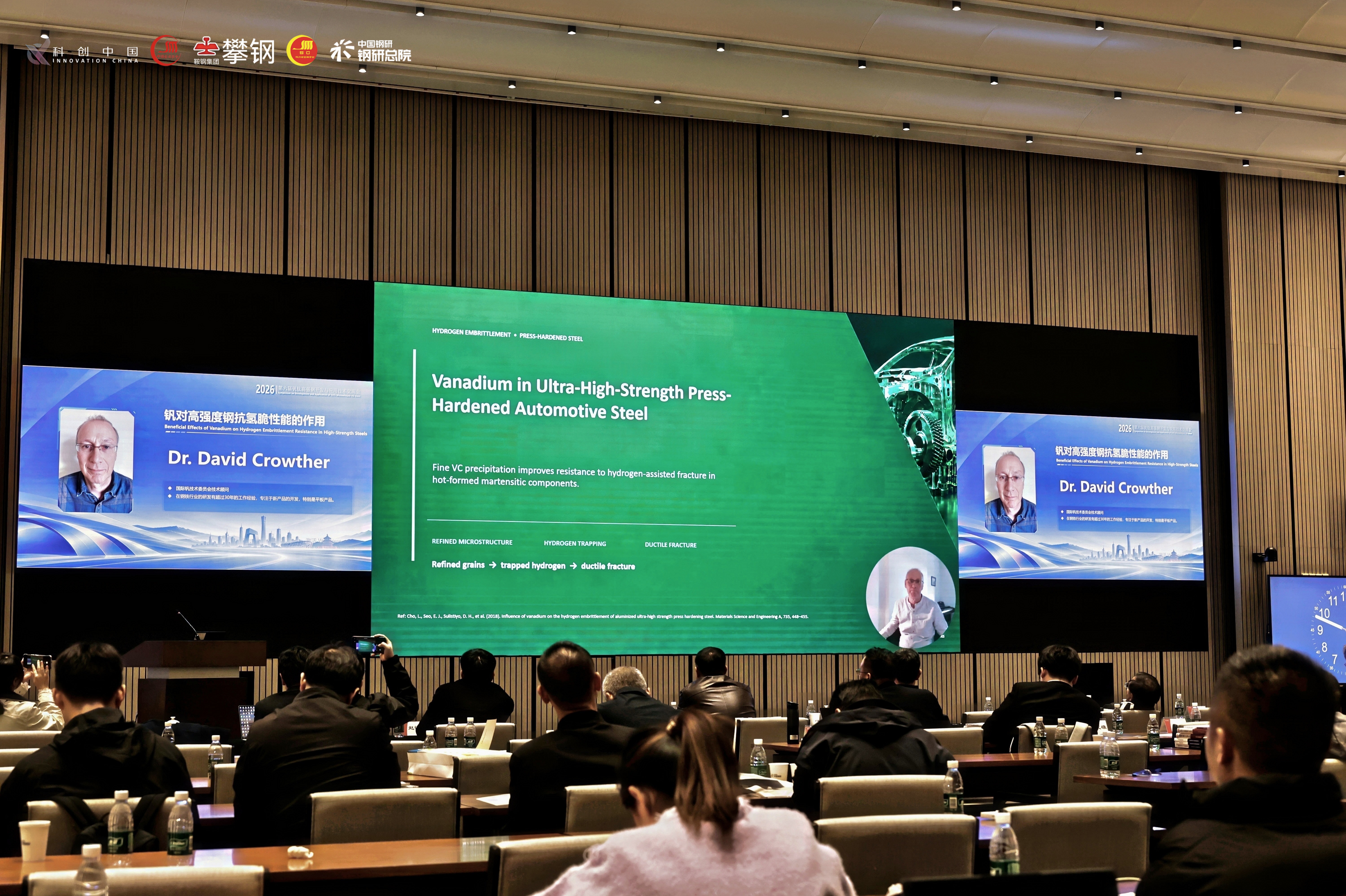
3 November 2026 — Vanadium microalloying can play a significant role in overcoming one of the most challenging limitations of high-strength steels: hydrogen embrittlement. This was the central message delivered by Dr David Crowther of Vanitec during the 6th Conference on the Development and Application of Vanadium–Titanium Microalloyed High-Strength Steels, held in Beijing, China, on 2–3 November 2026.
In his presentation, “Beneficial Effects of Vanadium on Hydrogen Embrittlement Resistance in High-Strength Steels,” developed with Dr Yu Li of Vanitec, Dr Crowther highlighted research demonstrating how small additions of vanadium can substantially improve steel resistance to hydrogen-assisted cracking while maintaining the high strength required for demanding industrial applications.
Hydrogen embrittlement is a major concern for advanced high-strength steels. Hydrogen entering steel during manufacturing, processing or service can accumulate at vulnerable locations, reducing ductility and toughness and potentially causing premature cracking or delayed failure.
As industries increasingly demand stronger, lighter and more durable steel products, controlling hydrogen embrittlement becomes essential for material reliability and performance.
How Vanadium Helps Protect High-Strength Steel
A key benefit of vanadium is its ability to form extremely fine vanadium carbide (VC) precipitates within the steel microstructure.
These nanoscale particles act as effective hydrogen traps, reducing the mobility of hydrogen atoms and limiting their accumulation at grain boundaries, defects and crack tips, where hydrogen-assisted damage can develop.
Vanadium also contributes to microstructural refinement, making crack propagation more difficult and helping steel retain ductility and toughness.
Together, these mechanisms provide two complementary benefits:
- Reduced hydrogen mobility: Fine vanadium carbide precipitates trap hydrogen and restrict its movement towards vulnerable regions.
- Improved resistance to cracking: Grain refinement and precipitation effects help preserve ductility, fracture toughness and resistance to delayed fracture.
The presentation demonstrated that vanadium's contribution goes beyond conventional strengthening, offering an additional means of improving the reliability of high-performance steels.
Research Demonstrates Significant Improvements
Dr Crowther presented published research covering several important steel applications, with results demonstrating the potential benefits of vanadium microalloying.
Automotive steels — improved ductility and fracture resistance
In ultra-high-strength press-hardened automotive steels with tensile strengths of approximately 1,800–2,000 MPa, the addition of 0.2% vanadium was shown to improve resistance to hydrogen-assisted fracture.
Research demonstrated that vanadium-containing steels maintained approximately 5.5% elongation after one week of ageing, while providing up to 40 MPa higher strength. Fracture examinations also showed ductile fracture surfaces in the vanadium-containing steels, compared with brittle fracture regions observed in the vanadium-free counterparts.
These findings are particularly relevant to automotive manufacturers seeking to use ultra-high-strength steels for lightweight vehicle structures without compromising structural integrity.
Ferritic steels — superior hydrogen trapping performance
Research comparing vanadium carbide with titanium carbide precipitates demonstrated that vanadium carbide can provide more effective hydrogen trapping and a better balance of strength and resistance to hydrogen embrittlement.
In the reported tests, the vanadium-containing steel with fine vanadium carbide precipitates exhibited a significantly lower hydrogen embrittlement index of 14.7%, compared with 37.0% for the titanium-containing steel with larger, semi-coherent titanium carbide precipitates.
The findings highlight the importance of fine precipitate size, distribution and trapping characteristics in designing hydrogen-resistant steels.
Pressure vessel steels — approximately 85% lower hydrogen diffusivity
One of the key findings concerned chromium-molybdenum-vanadium steels used in demanding hydrogen-service environments.
Research showed that fine molybdenum-vanadium carbide precipitates reduced apparent hydrogen diffusivity by approximately 85% compared with vanadium-free steel.
Hydrogen desorption tests revealed that 95% of the initial hydrogen remained trapped after 72 hours at room temperature, compared with only 33% in vanadium-free steel.
Fracture-toughness testing also showed a reduction in the hydrogen embrittlement index from 44.5% to 19.3%, representing a 57% improvement.
These findings highlight the potential of vanadium-containing steels for pressure vessels and other components exposed to hydrogen-related degradation.
Fatigue resistance — limiting hydrogen-accelerated crack growth
Research on chromium-molybdenum-vanadium steel also demonstrated that vanadium-containing precipitates can significantly reduce hydrogen-assisted fatigue crack propagation.
Under the reported test conditions, hydrogen accelerated fatigue crack growth in vanadium-free steel by approximately four to twelve times. In the vanadium-containing steel, no measurable hydrogen-induced acceleration was observed.
This is particularly relevant to components subjected to repeated loading, where fatigue crack growth can determine long-term service life.
Advancing Vanadium Technology Through International Collaboration
The 6th Conference on the Development and Application of Vanadium–Titanium Microalloyed High-Strength Steels, held at the Central Iron & Steel Research Institute (CISRI) in Beijing, brought together researchers, steel producers and industry specialists to explore advances in high-performance steel technology.
A key highlight of Vanitec's participation was Dr Crowther's presentation, which showcased the growing importance of vanadium in developing stronger, more durable and reliable steels for increasingly demanding industrial applications.
His presentation reinforced vanadium's value beyond its well-established strengthening benefits, highlighting its potential to enhance steel performance, improve resistance to hydrogen-related degradation and support emerging industrial needs.
Through its participation in this international conference, Vanitec reaffirmed its commitment to promoting the benefits of vanadium, fostering industry collaboration and supporting innovation in advanced steel technologies. As performance requirements continue to evolve, vanadium is well positioned to play an increasingly important role in the future of high-performance steels.
Dr Crowther’s presentation “Beneficial Effects of Vanadium on Hydrogen Embrittlement Resistance in High-Strength Steels” is attached for further insights into the important role of vanadium in enhancing steel performance and supporting advanced steel applications.